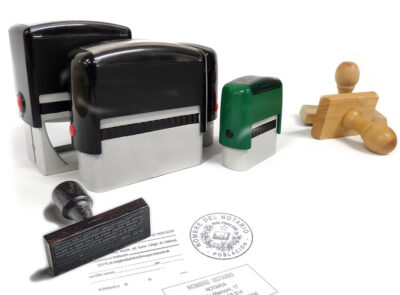
In the administrative, business, and even personal spheres, stamps remain essential tools for authenticating documents, marking repetitive information, or simply adding a more professional touch to any process. However, when choosing between a manual and an automatic stamp, doubts arise. Which one is better? The reality is that there is no single, absolute answer, as everything depends on the intended use and the needs of each individual or institution. In this article, we will explore the differences, advantages, and benefits of each type of stamp, as well as some practical tips for making the best decision.
Key differences between manual and automatic seals
Manual and automatic stamps fulfill the same basic function: transferring ink with an image, logo, or text onto paper. However, the way they do so is different. The manual stamp requires an external pad to be soaked with ink before being applied, whereas the automatic stamp already incorporates a mechanism that inks the surface when pressed.
This technical difference has important implications for how they are used. Manual seals are usually simpler and more robust, but require more steps to press them, whereas automatic seals reduce the process to a single movement.
As for the presentation, manual stamps usually have more artisanal or traditional designs, with wooden or plastic handles. Automatic ones, on the other hand, tend to be more modern and practical, with compact structures that are ideal for the contemporary office.
Durability is also a factor to consider. A manual seal can last practically the entire life of the product if it is cared for properly and the gasket is replaced when necessary. Automatic seals, although more convenient, depend on mechanical parts that can wear out faster over time.
Finally, the price difference is notable. Manual stamps are usually cheaper to purchase initially, while automatic stamps, due to their complexity and mechanism, represent a larger investment. In this regard, choosing one or the other will depend heavily on the available budget and the level of use to be given to it.
Practical advantages of using a traditional manual stamp
Manual stamps have the advantage of their simplicity. Since they do not depend on complex mechanisms, they are less prone to failure. A manual stamp can be used on virtually any surface with the appropriate pad, making them more flexible compared to some automatic ones, which are designed primarily for paper.
Another important advantage is their durability. Since they are made from sturdy materials such as wood or metal, manual seals can withstand prolonged use, maintaining their shape and accuracy over time. In fact, many traditional offices and offices still prefer them due to their reliability.
The maintenance cost is also minimal. Replacing a ink pad is extremely economical and requires no technical knowledge. Furthermore, different ink colors can be used easily, providing versatility for specific tasks.
From an aesthetic perspective, handmade stamps have a special appeal. For some, the classic style conveys a sense of authenticity and seriousness. Even in creative sectors, they are used to give a handcrafted and personalized touch to packaging or documents.
Customization is also easier with manual stamps, as they easily adapt to special designs, large formats, or unusual shapes. This makes them ideal for those looking to mark items that are different from the standard.
In conclusion, the manual seal is the ideal option for those who value tradition, durability and flexibility, as well as for those who do not need extreme speed in every use.
Benefits and conveniences of a modern automatic seal
The automatic stamp stands out primarily for the speed and convenience it offers. Since it does not require an external pad, simply pressing the button is enough to obtain a clean and instant printout, which is very efficient in offices with a high volume of documents.
Another advantage is uniformity. Automatic seals usually ensure uniform pressure, preventing any spots or irregular patterns. This is especially useful in business environments where professional image is a priority.
Ergonomics is also an important aspect. Automatic seals are designed to reduce effort, making them ideal allies in repetitive tasks. Using them for hours is much less tiring than resorting to a manual seal with a separate pad.
In terms of cleanliness, the automatic ones also have an advantage. By carrying integrated ink, the risk of getting your hands dirty or smudging the documents is reduced, a detail that makes a difference in the day-to-day work of any office.
In addition, modern models allow for easy refilling or replacement of ink cartridges, extending their lifespan. Many even feature special inks that are resistant to water or time, which is useful for legal documents.
In short, the automatic seal is perfect for those who need speed, convenience, and consistently clean results, although this does involve a slightly higher investment.
How to choose the ideal seal based on your needs
When choosing between a manual or automatic seal, the first thing to evaluate is the volume of use. If you need to stamp occasionally, a manual seal might be more than enough. For intensive, everyday use, the automatic one will be more efficient.
Budgeting also plays a key role. Manual stamps are more affordable, but if you have additional resources and are looking for convenience, automatic stamps represent an excellent investment in the medium term.
Another aspect to consider is the image you want to project. A handmade stamp can convey a touch of craftsmanship or tradition, while an automatic one reflects modernity and order. Choosing one or the other will also depend on the identity of your office or business.
If versatility is important to you, the manuals allow you to easily use different inks and surfaces. On the other hand, if speed and cleanliness are essential, the automatic ones take the lead.
Before deciding, you also consider the durability you are looking for. If you opt for something that practically requires no maintenance, the manual is the safest option. On the other hand, if you prioritize comfort and you don't mind performing periodic replacements, the automatic one will be your ally.
Ultimately, there is no better or worse stamp in absolute terms; it all depends on balancing the use, budget, and identity you want to convey with each print.
Manual and automatic stamps, despite their technical and aesthetic differences, serve the same purpose: to facilitate the authentication and organization of documents. However, the best choice will depend on the context in which they are used. If you are looking for durability, versatility, and a classic style, the manual stamp remains a reliable tool. On the other hand, if you need speed, cleanliness, and practicality in repetitive tasks, the automatic stamp is an excellent option. Ultimately, what matters is that the stamp you choose adapts to your work pace and helps you optimize your daily tasks.